

Moisture Index
- Home
- »
- Search
- »
- Africa
- »
- Continental Africa
- »
Data Sets
Dekadal Period
Continental Africa
Loading subregion products...
Product Documentation
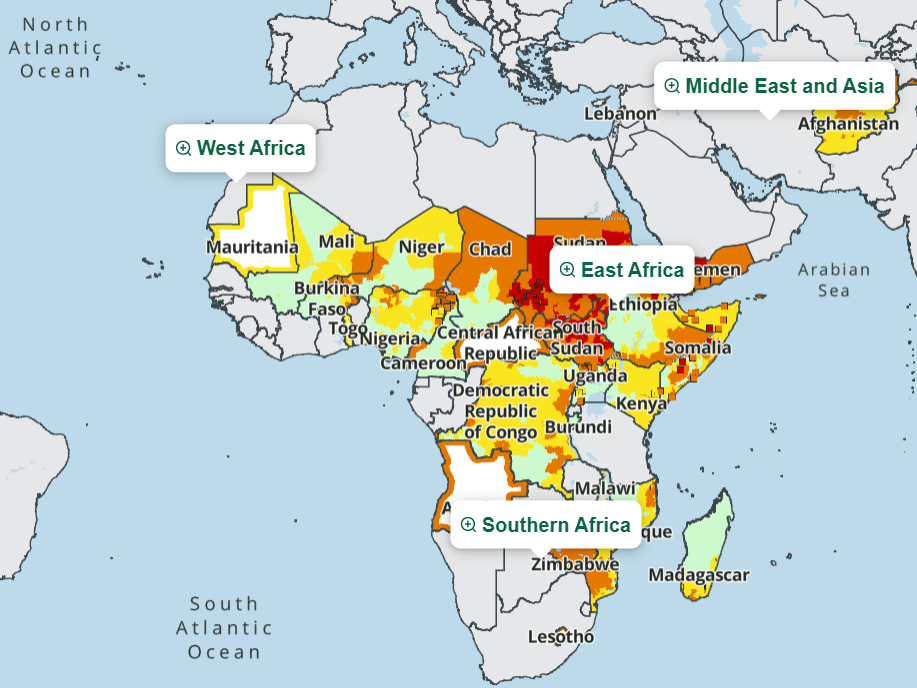
The moisture index (MI) is an agrometeorological indicator defined by a simple supply/demand ratio, then multiplied by 100 to provide a percent value. The MI is determined by [(PPT + SW) / PET] * 100 where PPT is dekadal rainfall (mm), SW is available soil water (mm), and PET is dekadal potential evapotranspiration (mm). As a stand-alone product the dekadal MI images provide additional information concerning moisture available for crops, enhancing the information provided by the RFE images. In order to calculate the dekadal MI on a spatial basis, the RFE images are used directly for PPT, as are PET grid values computed from the GDAS (Global Data Assimilation System) analysis fields. A simple bucket model (defined by the water holding capacity (WHC) of the soil and the crop root depth) is used to calculate a new value of SW for each dekad, i, wherein SWi = SWi-1 + PPTi - PETi where SWi is subject to the constraint 0 <= SWi <= WHC. Soil water in excess of WHC is assumed to be lost as runoff or drainage out of the first 100-cm layer of soil. GDAS analysis fields, generated every 6 hours, are used to estimate dekadal PET on a spatial basis using the Penman-Monteith equation (the formulation of Shuttleworth (1992) for reference crop evaporation is used). GDAS fields used include air temperature, atmospheric pressure at the surface, wind, relative humidity, and radiation (long wave, short wave, outgoing, and incoming). PET is computed for each day, and appropriate sums are made to obtain dekadal totals. The spatial variation of soil water holding capacity (WHC) is characterized using the FAO Digital Soil Map of the World (FAO, 1994). The scale of the original mapping is 1:5,000,000, and the soil polygons carry attributes that include an estimate of easily available water capacity in the upper 100 cm, based on soil physical characteristics. These values were adopted for calculation of soil water conditions. The FAO soil map has been rasterized at a scale that matches the 0.1-degree RFE grid. Shuttleworth, J., 1992. Evaporation. Chapter 4 in Handbook of Hydrology. (D.Maidment, ed.). McGraw-Hill, Inc., New York. |